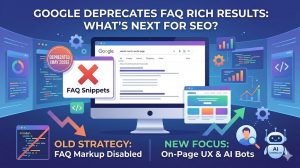
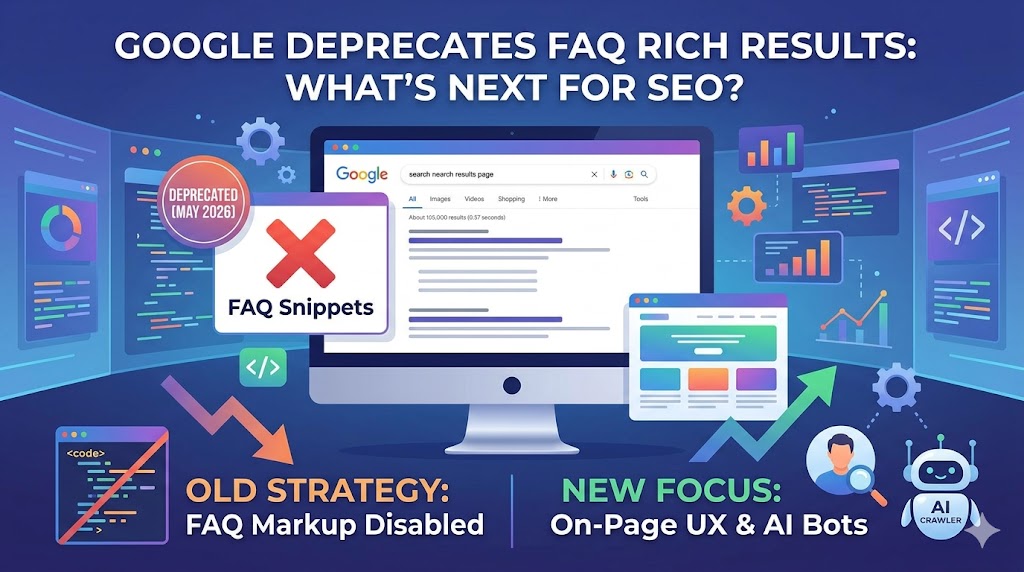
Google has officially announced the complete deprecation of FAQ Rich Results from search pages. For years, adding FAQ schema markup was a go-to strategy for SEO professionals to capture more real estate on the Search Engine Results Pages (SERPs) and boost organic Click-Through Rates (CTR).
However, as of May 7, 2026, Google has officially put an end to this feature.
In this article, we’ll break down exactly what this change means, Google’s phase-out timeline, and what actionable steps you should take next to safeguard your website’s SEO.
The History: How We Got Here
This isn’t an overnight decision. Google has been scaling back FAQ rich results for a while:
- August 2023: Google limited FAQ rich results only to authoritative Government and Health websites, removing them for the vast majority of commercial and blog sites.
- May 2026: Google completed the cycle by removing the feature entirely—even for those government and health websites.
Now, no website, regardless of its niche or authority, will show the traditional expandable FAQ dropdowns in Google search results.
Google’s Official Deprecation Timeline (2026)
Google is phasing out the backend support for FAQs in stages to give developers time to adjust their systems:
| Date | What is Changing? |
| May 7, 2026 | FAQ rich results completely stopped appearing in Google Search. |
| June 2026 | Google will remove FAQ reports from Search Console, the Search Appearance filter, and the Rich Results Test tool. |
| August 2026 | Search Console API support for FAQ rich results will be permanently shut down. |
Why Did Google Kill FAQ Rich Results?
While Google hasn’t explicitly deep-dived into the philosophy behind the move, SEO experts point to two major reasons:
- The Rise of Generative AI (SGE): Google’s search engine is rapidly shifting toward an AI-first model. With AI-generated overviews and direct citations, the old-school accordion-style FAQ dropdowns became redundant.
- Spam and SERP Clutter: Many webmasters abused FAQ schema purely to hog vertical space on the first page, often providing thin or low-quality answers just to manipulate CTR.
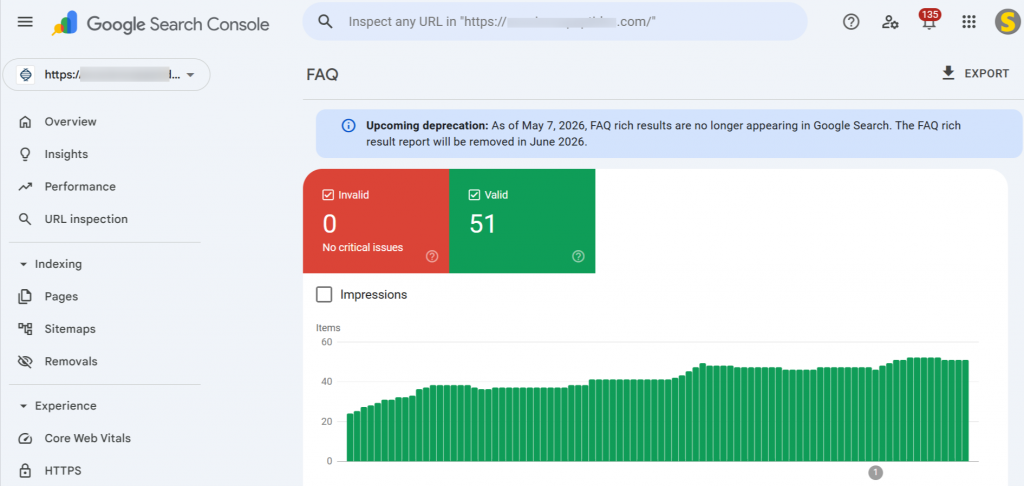
Google will remove FAQ reports from Search Console, the Search Appearance filter, and the Rich Results Test tool. To understand how to monitor your other remaining performance metrics, check out our Complete Google Search Console Guide
What Should You Do Next? (Action Plan for SEOs)
🛑 Do NOT Delete Your FAQ Schema Code!
The most common panic reaction is to go into the website code and delete all
FAQPagestructured data. Don’t do this. Google has explicitly stated that leaving the schema markup on your pages will not harm your site or trigger any penalties.
Here is what you should actually do:
1. Leave the Code, but Optimize for AI Bots
Even if Google Search doesn’t display the dropdowns, search engine crawlers, LLMs (Large Language Models), and other search engines (like Bing) still read structured data. Leaving the schema intact helps AI understand the context of your page, which can help your content get cited in AI-generated answers.
2. Export Your Historical Data (Before June 2026)
Once June hits, Google Search Console will wipe the FAQ performance report. If you want a record of how much traffic your FAQs used to bring in for historical reporting or client updates, export your Search Console data now.
3. Update Your API Calls
If you use automated SEO dashboards or custom tools that pull data from the Search Console API, notify your development team. They need to remove or update the FAQ rich result queries before the API deprecates in August 2026 to prevent system errors.
4. Pivot to On-Page UX and Helpful Content
Since you can no longer rely on rich snippets to stand out, your focus must shift entirely to the quality of the content. Make sure your actual on-page FAQs are naturally integrated, easy for users to read, and genuinely helpful.
Final Thoughts
The death of FAQ rich results is a clear reminder that Google is moving away from superficial search hacks and moving closer to an intuitive, AI-driven answers engine. Instead of mourning lost SERP real estate, the best path forward is to build highly informative, structured content that AI search engines cannot afford to ignore.
Instead of mourning lost SERP real estate, the best path forward is to build highly informative content. If you have noticed a sudden decline in your analytics due to recent changes, read our strategic playbook on how to recover lost Google rankings.