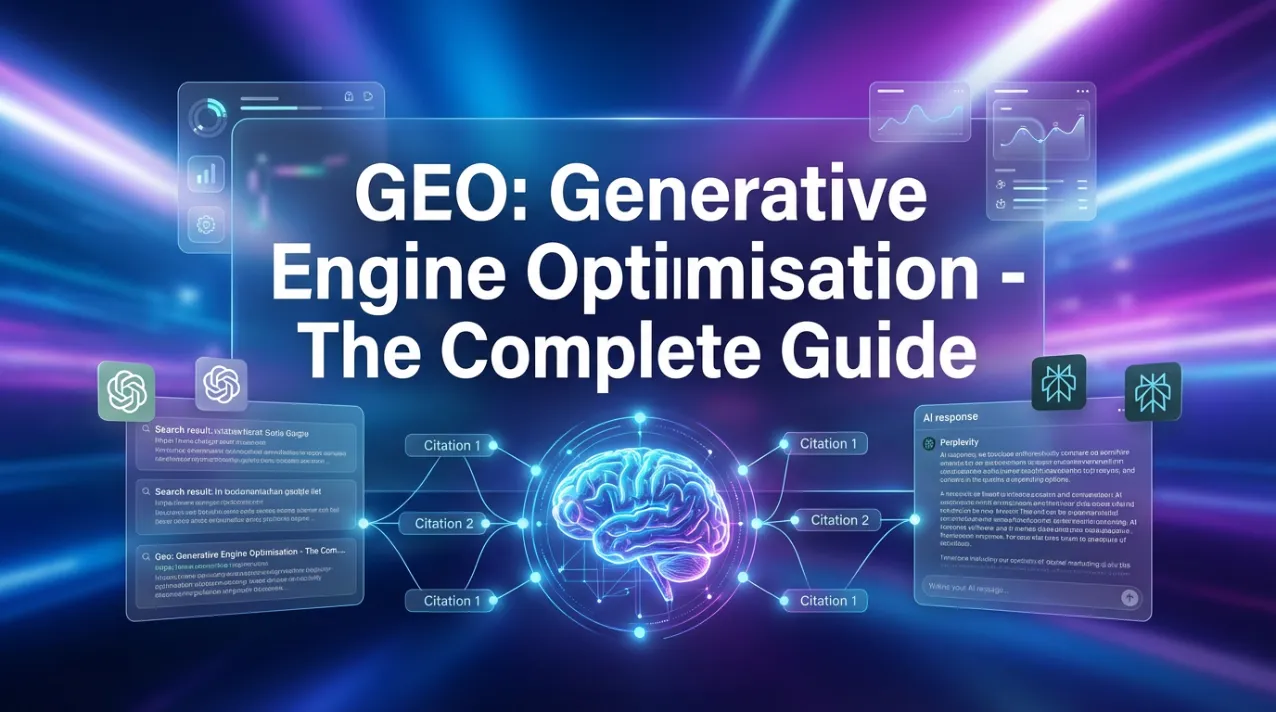
GEO — Generative Engine Optimisation — is the discipline of optimising your content and website to be discovered, retrieved, and cited by AI-powered search platforms. In 2026, this means Google AI Overviews, ChatGPT with search, Perplexity AI, Microsoft Copilot, and the expanding universe of AI assistants that answer user questions by pulling content from the web.
Traditional SEO gets you traffic from people who click on search results. GEO gets your content cited as a source by AI systems that millions of people consult daily — often without clicking through to any website at all.
This guide explains exactly what GEO involves, why it is now a core part of any serious SEO strategy, and the specific tactics that get content cited by AI systems.
Why GEO Matters in 2026
The scale of AI search has crossed a threshold that cannot be ignored:
- ChatGPT processes an estimated 2.5 billion prompts per day as of mid-2025
- Perplexity AI has grown to tens of millions of active users, primarily high-income professionals and researchers
- Google AI Overviews now appear for a substantial proportion of all search queries in the US, UK, and major global markets
- Microsoft Copilot is integrated directly into Windows, Office, and Bing — making it the default AI assistant for hundreds of millions of users
Collectively, these platforms have captured a meaningful and growing share of information-seeking behaviour that previously resulted in Google organic traffic. If your content is not being cited by these platforms, you are invisible to a growing segment of your potential audience.
GEO is not a replacement for traditional SEO — it is an extension of it. The sites winning in AI citation are almost always strong traditional SEO performers. But strong traditional SEO is no longer sufficient on its own.
How AI Search Engines Find and Cite Content
Understanding the mechanics of how AI systems retrieve and cite content is the foundation of effective GEO.
Retrieval Augmented Generation (RAG)
Most AI search systems use a technique called Retrieval Augmented Generation (RAG). When a user asks a question, the AI:
- Searches the web or its index for relevant documents
- Retrieves the most relevant passages from those documents
- Generates a response synthesising those passages
- Cites the sources it retrieved from
Your content needs to win at step 2 — being the passage that is retrieved. This is different from traditional SEO (where you need to rank as a URL) because RAG operates at the passage level, not the page level.
A single, well-written, specific paragraph can be retrieved and cited even if your overall page does not rank #1 for the query.
How Passage Retrieval Works
AI systems use embedding models to measure semantic similarity between a user’s question and passages in their index. Passages that are:
- Semantically dense (saying a lot in few words)
- Directly relevant to the query (not tangentially related)
- Factually specific (numbers, names, dates, results)
- Clearly structured (starts with the topic, develops it, concludes)
…score higher in passage retrieval than passages that are vague, general, or buried in tangential content.
The 6 Core GEO Optimisation Strategies
Strategy 1: Write Retrievable Passages, Not Just Good Articles
Traditional SEO rewards long, comprehensive articles. GEO rewards individual passages within those articles that are independently retrievable.
What makes a passage retrievable:
- It starts with the key fact or answer, not context or setup
- It is self-contained — someone reading only this paragraph understands the point
- It contains specific, citable information — not “many SEO experts believe” but “a 2025 study of 500 websites found that…”
- It is concise — 2–5 sentences is the ideal passage length for AI retrieval
Example of a non-retrievable passage:
“When it comes to thinking about the various issues that might affect your website’s performance in search engines, it is important to consider a range of technical and content-related factors that Google and other search engines use to evaluate the quality and relevance of your pages.”
Example of a retrievable passage:
“The three most common causes of a sudden Google traffic drop are: a core algorithm update (which affected 40–60% of sites in March 2026), a technical crawl error such as a robots.txt block or accidental noindex tag, and loss of backlinks. Technical errors are the fastest to fix — most are resolvable within 2–4 weeks of identification.”
The second version is specific, citable, self-contained, and directly answers a likely query.
Action: Go through your top articles and identify your best paragraphs — the ones that contain your most specific, valuable information. Restructure each article so these paragraphs appear near the top, not buried on page 3.
Strategy 2: Structure Content Around Questions AI Systems Are Asked
AI search systems are asked questions, not keyword queries. A user asks ChatGPT “why did my Shopify store lose Google traffic?” not “Shopify traffic drop SEO fix.”
GEO-optimised content is structured around natural language questions — specifically, the questions that your target audience is asking AI systems.
How to find the right questions:
- Use Google’s “People Also Ask” boxes — these reflect real question formats users type into search
- Use Perplexity AI or ChatGPT — ask them about your topic and note what related questions they generate or suggest
- Talk to your clients — the exact questions clients ask you in conversations are exactly what they are typing into AI systems
- Use AnswerThePublic or AlsoAsked for structured question research
Implementation:
Convert every H2 and H3 in your articles to question format where natural:
Before: “Causes of Crawled — Currently Not Indexed”
After: “Why does Google crawl pages but not index them?”
Before: “How to Fix the Issue”
After: “How do I get my pages indexed after fixing crawl issues?”
AI systems match user questions to content headings — question-format headings are more likely to be retrieved.
Strategy 3: Build Topical Authority Through Content Clusters
AI systems evaluate source authority at the domain level. A site that comprehensively covers a topic — with multiple interlinked articles covering different aspects of the same subject — signals domain expertise to AI retrieval systems.
A single excellent article about GSC errors on a domain that otherwise covers lifestyle topics is less likely to be cited than an equally good article on a domain that is comprehensively dedicated to technical SEO.
GEO implication for 3wBiz: Your cluster of 16+ GSC error articles, when properly interlinked, signals to AI systems that 3wBiz.com is an authoritative domain on Google Search Console issues. This is why internal linking is not just traditional SEO good practice — it is a GEO signal.
Action: Ensure every cluster of related articles on your site is tightly interlinked. AI systems follow link graphs to understand topical authority, similar to how traditional PageRank works.
Strategy 4: Publish Original Data and Research
AI systems are specifically designed to synthesise information and provide new insights. When your content contains original data — statistics from your own research, results from your client work, surveys you conducted — AI systems have strong incentive to cite you, because your data cannot be found anywhere else.
Original data is the single most powerful GEO differentiator.
Practical ways to create original data as an SEO agency:
- Client case studies (anonymised): “In our audit of 50 WordPress sites, we found that 78% had at least one unresolved GSC error affecting indexing.”
- Analysis of publicly available data with your own interpretation: Analyse patterns in GSC data across multiple sites you manage
- Industry surveys: Survey your clients or LinkedIn audience about their most common SEO challenges — even 30 responses generates citable data
- Before/after results: Document specific, measurable results from your fixing services: “After implementing our crawl budget recommendations, Client X saw indexed pages increase from 2,400 to 3,100 within 6 weeks.”
Even simple, small-scale original research dramatically increases the citation rate of the articles that contain it.
Strategy 5: Implement Comprehensive Schema Markup
Schema markup is the language search engines and AI systems use to understand your content structure. Properly implemented schema makes your content significantly more machine-readable — which directly improves retrieval rates.
Priority schema types for GEO:
FAQPage schema — Mark up every FAQ section. This is one of the highest-impact GEO implementations because FAQ format directly mirrors how users query AI systems.
Article schema with Author — Signals to AI systems that this content has a named, verifiable human author with relevant expertise. See our Author Schema guide.
Organisation schema — Establishes your site as a real, identifiable entity. See our Organisation Schema guide. AI systems preferentially cite content from identifiable organisations over anonymous sources.
HowTo schema — For step-by-step guides (like our GSC error fix articles), HowTo schema makes the steps directly machine-readable.
BreadcrumbList schema — Helps AI systems understand your site’s content hierarchy and topical structure.
Strategy 6: Earn Brand Mentions and Citations Across the Web
AI systems are trained on the web and fine-tuned using signals including which sources are cited by other authoritative sources. If your brand name and your domain appear in authoritative industry publications, forums, and community sites, you build the “citation footprint” that makes AI systems more likely to retrieve and cite you.
Practical ways to build citation footprint:
- Guest articles on SEO publications — Search Engine Journal, Search Engine Land, Moz Blog, Ahrefs Blog. Even one well-placed guest article can meaningfully increase AI citation rates.
- Contribute to industry communities — Answer questions in Reddit’s r/SEO, Google’s Search Central Community, and relevant Facebook groups. Authoritative community contributions build mentions.
- Be quoted in roundups — Respond to HARO (Help a Reporter Out) or Qwoted requests for SEO expert quotes. Press mentions count disproportionately in AI training data.
- Podcast appearances — Many podcasts publish transcripts that are indexed and retrievable. An interview on an SEO or digital marketing podcast generates retrievable content associating your expertise with the topic.
GEO vs SEO: What Changes and What Does Not:
| Factor | Traditional SEO | GEO |
|---|---|---|
| Target | Rank URL in top 10 | Get passages cited in AI responses |
| Unit of content | Full article/page | Individual passages and FAQs |
| Keyword format | Keyword phrases | Natural language questions |
| Author identity | Nice to have | Essential for trust signals |
| Schema markup | Beneficial | Critical |
| Original data | Differentiating | Highest-impact GEO factor |
| Backlinks | Primary authority signal | Important for domain trust |
| Content freshness | Helpful | More critical for time-sensitive queries |
| Topical clusters | Good SEO practice | Explicit GEO authority signal |
What does not change: content quality, technical SEO fundamentals, domain authority, and the need to be genuinely helpful to your target audience. GEO raises the bar for all of these rather than replacing them.
Measuring GEO Success
Unlike traditional SEO (where ranking positions and organic clicks are easily tracked), GEO is harder to measure directly. Useful proxies include:
Brand mention monitoring: Set up Google Alerts and Brand24 for your domain and brand name. Track whether brand mentions increase on authoritative sites and in AI-generated content.
Direct traffic from AI sources: Some AI platforms (Perplexity, ChatGPT) are now appearing as referral sources in Google Analytics. Monitor these specifically.
GSC click-through rate: If you are being cited in AI Overviews, the pages cited typically see improved CTR even as some traffic shifts to AI. An improving CTR without additional ranking improvements is often an AI citation signal.
Manual testing: Regularly search your target queries in Perplexity, ChatGPT, and Google AI Overviews. Note which of your articles (if any) are being cited. This is the most direct measurement available.
GEO for Technical SEO Agencies
For 3wBiz specifically, GEO is a significant opportunity because:
- The queries relevant to your services (“how to fix GSC errors,” “why did my ecommerce traffic drop,” “google core update recovery”) are precisely the queries people increasingly bring to ChatGPT and Perplexity
- Technical SEO content with specific, actionable steps is exactly the type of content AI systems are designed to surface
- Your target audience (website owners, marketing managers, ecommerce operators) are among the heaviest users of AI search tools
A single citation in a Perplexity response for “how to fix a 404 error in GSC” that is seen by 10,000 users per month is as valuable — arguably more valuable — than ranking position 3 in traditional Google results.
The AI citation strategy and the traditional SEO strategy for 3wBiz are almost identical: comprehensive, specific, technically accurate content about GSC errors and SEO recovery, written by identifiable experts, published on a domain with growing topical authority. The GEO layer adds: original data, question-format headings, FAQ schema, and a focused brand mention building campaign.
Getting Started With GEO Today
Week 1 — Quick wins:
- Add FAQ sections with FAQPage schema to your top 10 articles
- Rewrite H2/H3 headings to question format across your best-performing articles
- Implement Article schema with author property on all content
Month 1 — Foundation:
- Audit your top 20 articles for retrievable passages — restructure so key facts are in the opening paragraphs
- Set up brand mention monitoring (Google Alerts + Brand24)
- Begin one guest article outreach campaign to an SEO publication
Ongoing:
- Publish one article per month containing original data or a client case study
- Monitor Perplexity and ChatGPT monthly for brand citations
- Build internal linking to strengthen topical cluster signals
For a complete GEO audit and implementation strategy for your site, get a free consultation with our team. Our AI writing service also produces GEO-optimised content built to the standards described in this guide.