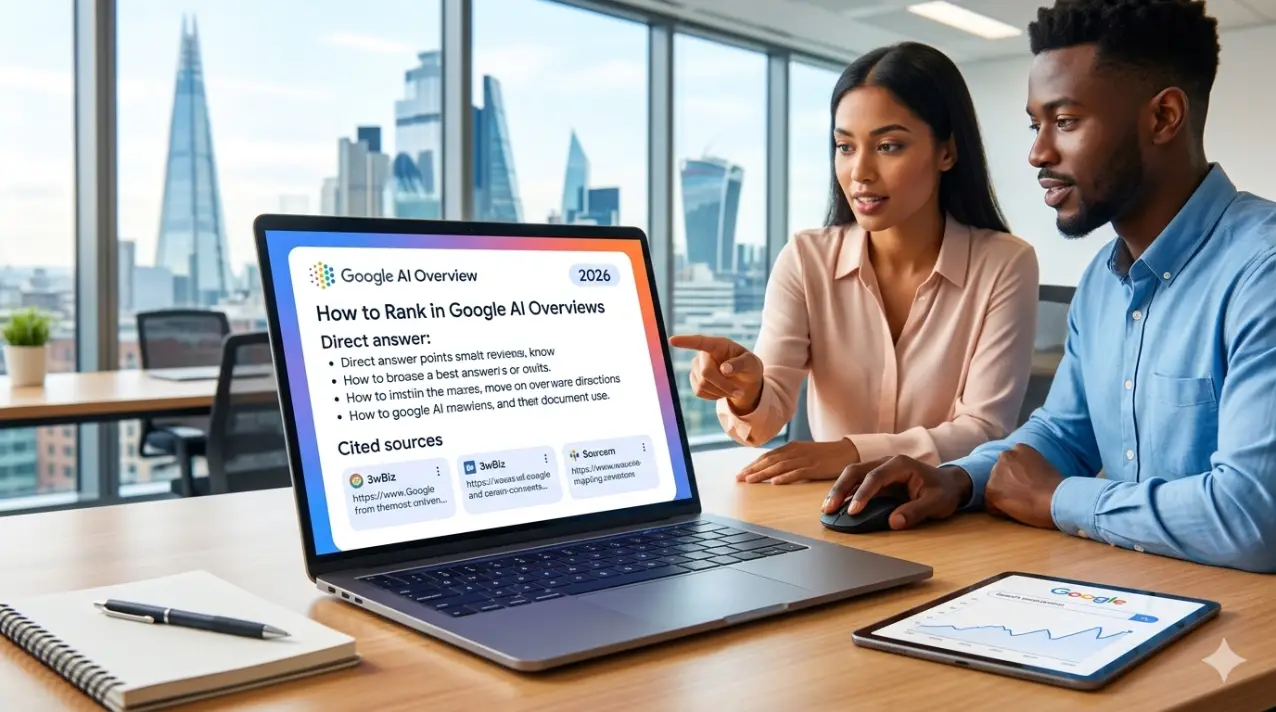
Google AI Overviews (formerly SGE — Search Generative Experience) now
appear for millions of search queries globally. They are the large
AI-generated summaries that appear at the top of Google’s search
results, above organic listings, complete with cited sources.
Being cited as a source within an AI Overview is the new “position zero”
— it is more visible than any traditional ranking position, and research
suggests it increases brand clicks by 35% or more compared to an
un-cited organic listing appearing below an Overview.
This guide explains exactly how Google AI Overviews work, what
determines which sources get cited, and what you need to do to optimise
your content for AIO citation.
How Google AI Overviews Select Sources
Google has not published a precise algorithm for AI Overview source
selection, but extensive analysis of AIO appearances in 2025–2026
reveals consistent patterns:
Highly ranked pages are the starting point, but not the
endpoint.
Google’s AI Overviews typically pull from pages that are already ranking
in the top 10–20 for the query. However, appearing in the top 10 does
not guarantee AIO citation — the content must also match specific
quality criteria.
Direct, specific answers to the query are prioritised.
The AI generates a summary answer, then attributes specific facts and
statements to their sources. Content that contains precise, citable
statements matching the query intent is far more likely to be selected
than content that discusses the topic generally.
Multiple sources are typically cited. AIO responses
typically cite 3–8 different sources. Being the single authoritative
source on a topic is not required — being a clear, citable source is.
Content structure matters. Google’s AI system retrieves
content in chunks. Content that is clearly structured — with
question-based headings, concise paragraphs, numbered steps, and direct
statements — is easier to chunk and retrieve accurately.
The 7 Factors That Determine AIO Citation
Factor 1: Traditional Organic Ranking
You must be ranking (or close to ranking) organically for a query before
AI Overviews will cite you for it. AIO citation and organic ranking are
deeply related — improving your traditional SEO is still the foundation.
If you are not yet ranking in the top 20 for your target keywords, AIO
optimisation is premature. Focus on your
technical SEO fundamentals
and content quality first.
Factor 2: Content That Directly Answers the Query
The AI generates an answer and then looks for sources that contain the
specific information in that answer. Content that contains direct,
precise statements matching what the AI is trying to say gets cited.
Structure your content to answer the query in the first 100 words. Do
not bury the answer at the bottom after three paragraphs of context.
Assume the AI is scanning your content for the most direct, relevant
passage.
Example:
Weak opening (unlikely to be cited):
“Understanding why websites lose Google traffic is an important topic in
the SEO community, and there are many different perspectives on the
causes and solutions…”
Strong opening (AIO-ready):
“Website traffic drops in Google are most commonly caused by one of five
things: a Google algorithm update, a technical crawl error (such as a
robots.txt block or 404 error), loss of backlinks, duplicate content
issues, or a Core Web Vitals failure.”
The second version is specific, structured, and citable. The AI can lift
that sentence and attribute it to your article.
Factor 3: E-E-A-T Signals (Experience, Expertise, Authoritativeness,
Trustworthiness)
Google’s AI Overview system is designed to surface authoritative,
trustworthy sources. Content that demonstrates genuine expertise and
experience is prioritised over generic content, even if the generic
content covers the same information.
How to strengthen E-E-A-T for AIO citation:
Author attribution: Every article should have a named
author with a detailed bio. The author should have verifiable
credentials relevant to the topic.
First-hand experience signals: Include original
screenshots, specific examples from real client work, or documented
personal testing. Not “most SEO experts agree that…” but “in our work
auditing over 1,000 websites, we consistently find that…”
Author Schema markup: Implement Article schema with a
proper author property linking to your author page. See our
author schema guide
for implementation instructions.
Organisation markup: Implement Organisation schema on
your homepage and about page. This helps Google confirm your site is a
legitimate, established entity. See our
organisation schema markup guide.
Factor 4: Content Freshness
AI Overviews for time-sensitive queries strongly favour recently updated
content. For SEO, algorithm updates, and technology topics — the exact
topics relevant to 3wBiz — currency is critical.
Practical actions:
-
Add the current year to your article titles where relevant (“2026
Guide,” “Updated March 2026“)
-
Update statistics and data points in your articles at least every 6
months
-
Add a “Last Updated” date to article headers and use dateModified in
your Article schema
-
When a major Google update occurs (like the March 2026 Core Update),
publish an article about it within days — freshness advantage is
time-limited
Factor 5: FAQ Sections With Structured Questions and Answers
FAQ sections are among the most frequently cited content structures in
AI Overviews. The question-and-answer format exactly mirrors the way AI
systems retrieve and present information.
Implement FAQ sections correctly:
Every significant article should end with a FAQ section addressing:
-
The 3–5 most common questions users ask after reading the article
-
Questions sourced from Google’s “People Also Ask” box for your target
keyword
- Questions that your customers or clients actually ask
Structure the FAQ for AIO retrieval:
## Frequently Asked Questions

### What is the most common cause of a sudden website traffic drop?

The most common cause of a sudden website traffic drop is a Google
core algorithm update. Google releases several major updates per year,
each of which recalibrates ranking signals.Sites with thin content,
poor E-E-A-T signals, or technical issues are most affected.

### How long does it take to recover traffic after a Google core update?

Recovery from a Google core update typically takes 1–3 months after
substantive content and technical improvements are implemented.
Some sites require multipleupdate cycles before full recovery.
Implement FAQ Schema markup on all FAQ sections. Use FAQ Page and
Question/Answer JSON-LD. This signals to Google that this content is
structured Q&A and dramatically increases AIO citation rate for these
sections.
Factor 6: Comprehensive Topic Coverage
AI Overviews cite sources that comprehensively cover the topic being
queried. A 600-word article covering one aspect of a topic is less
likely to be cited than a 2,000-word article that addresses all aspects
of the query, its causes, its implications, and its solutions.
How to ensure comprehensive coverage:
-
Search your target keyword in Google and open the current top 3
results
- Identify every subtopic they cover
-
Map against your article — are there subtopics they cover that you do
not?
- Add sections covering any gaps
-
Check the "People Also Ask" and "Related Searches" sections — these
reveal adjacent questions Google associates with your topic
This is also strong traditional SEO practice — comprehensive coverage of
a topic is a primary signal that your content deserves to rank.
Factor 7: Clean, Crawlable Technical Implementation
Even the best content cannot appear in AI Overviews if Google cannot
crawl and index it properly. Technical barriers are often invisible to
the site owner but completely block AI citation.
Minimum technical requirements for AIO citation:
-
Page must be indexed (check with URL Inspection in GSC — if it shows
"URL is not on Google", fix indexing first)
- Page loads in under 2.5 seconds LCP on mobile
- No noindex meta tag
- Not blocked by robots.txt
- Canonical tag points to the correct URL (no canonical issues)
- HTTPS active and properly configured
If any of these are failing, work through the relevant guides in our GSC
error articles before focusing on AIO content optimisation.
Step-by-Step AIO Optimisation Process
Follow this process for each article you want to appear in AI Overviews:
Step 1 — Confirm organic ranking. Check GSC or Ahrefs.
Is the article ranking in positions 1–20 for the target keyword? If not,
start here.
Step 2 — Rewrite the opening. Make the first 150 words
directly answer the primary query with specific, citable statements. No
preamble.
Step 3 — Convert subheadings to questions. Change H2s
from topic labels ("Causes of 404 errors") to direct questions ("What
causes a 404 error in Google Search Console?").
Step 4 — Add or improve the FAQ section. Minimum 5
questions based on People Also Ask and real user questions. Add FAQPage
schema.
Step 5 — Add original data or experience. Insert at
least one statement that only your site can make — from your own work,
your own research, your own clients.
Step 6 — Update the publication/modification date.
Refresh any outdated statistics. Add dateModified to your Article
schema.
Step 7 — Strengthen author attribution. Ensure the
article has a named author, that the author has a detailed bio page, and
that Article schema includes the correct author property.
Step 8 — Submit for recrawl. In GSC → URL Inspection →
Request Indexing. This accelerates Google recrawling the updated
version.
What AIO Optimisation Will NOT Do
It will not replace strong backlinks. Domain authority from quality
backlinks remains a prerequisite for AIO citation. Sites with no
backlinks pointing to them are rarely cited, regardless of content
quality.
It will not fix thin or shallow content. FAQ sections added to a
500-word article that barely covers its topic will not earn AIO
citation. The underlying content must be substantive.
It will not overcome technical SEO problems. If your pages are not being
properly indexed and crawled, no content-level optimisation matters.
It is not an instant result. AIO citations change based on Google's
evolving understanding of your content and site authority. Changes take
4–12 weeks to reflect in AI Overview appearances.
Tracking Your AIO Performance
GSC does not yet have a specific "AI Overview appearances" metric (as of
April 2026). Proxies to track your AIO performance include:
-
CTR changes for queries where you know AI Overviews appear — if AIO
citation increases, CTR from the organic listing below tends to
improve
-
Brand mention monitoring — tools like Brand24 or Google Alerts can
catch when your brand appears in AI-generated content citations
-
Manual checks — search your target keywords from different devices and
note when your site appears as a cited source in the AI Overview
For professional AI Overview tracking and reporting as part of a broader
SEO service, contact our team.
Summary
Appearing in Google AI Overviews is achievable for sites that combine
strong traditional SEO fundamentals with specific content adaptations:
direct answers in the opening, question-based headings, comprehensive
FAQ sections with FAQ schema, genuine E-E-A-T signals, and fresh,
specific content that Google's AI can clearly attribute to your site.
The sites winning in AI Overviews in 2026 are not doing anything
dramatically different from what Google has always rewarded — they are
just executing on content quality and technical SEO at a higher
standard, with greater attention to the structural formats that AI
systems can retrieve.
If you need help implementing AIO optimisation across your content
library, our AI writing service produces
AIO-ready content built around these principles. For a full SEO and AIO
strategy,
get a free consultation.
Related reading: