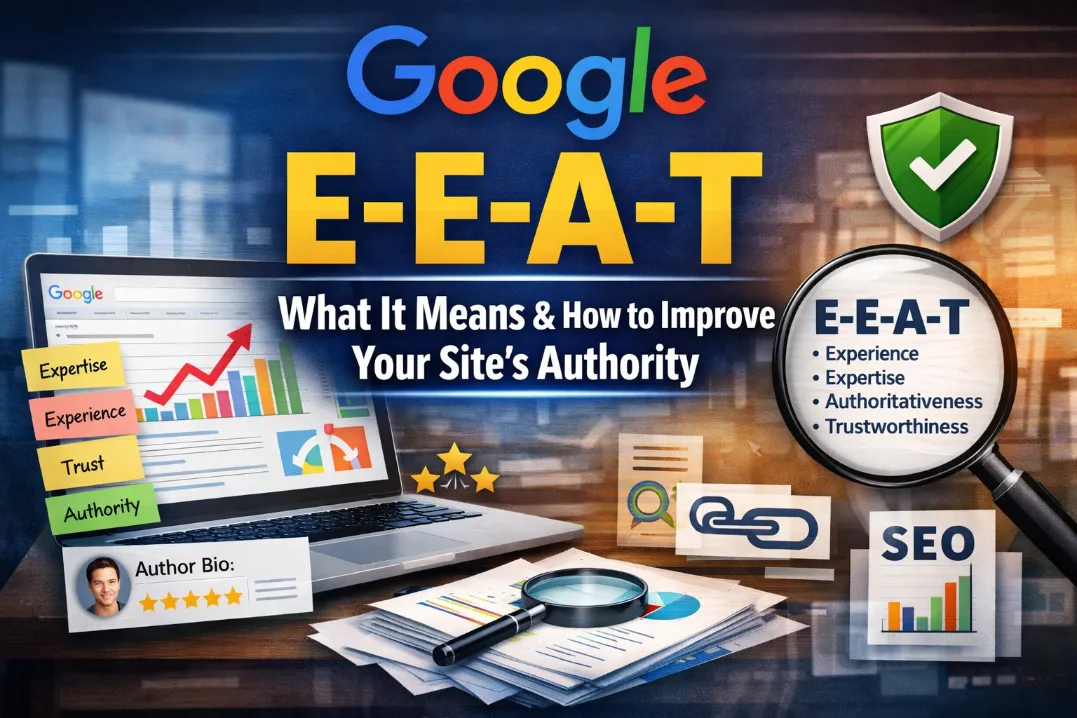
After the March 2026 Core Update, E-E-A-T has moved from being a quality guideline that SEOs acknowledged in theory to a ranking signal with measurable, practical impact. Sites that demonstrate genuine Experience, Expertise, Authoritativeness, and Trustworthiness recovered from the update. Sites that lacked these signals — regardless of their keyword optimisation — lost rankings.
This guide explains what each E-E-A-T component means, how Google evaluates it, and exactly what you can do to improve it.
What Is E-E-A-T?
E-E-A-T stands for Experience, Expertise, Authoritativeness, and Trustworthiness. It was originally E-A-T (without the first E) and was part of Google’s Search Quality Evaluator Guidelines — the document used by human quality raters to evaluate search results. In December 2022, Google added “Experience” as a component, making it E-E-A-T.
Critically: E-E-A-T is not a single ranking factor with an on/off switch. It is a framework Google uses to evaluate the overall quality and credibility of content and its publishers. Google’s algorithms infer E-E-A-T from hundreds of signals across your site, your authors, and your wider web presence.
E-E-A-T matters more for some topics than others. Google categorises high-stakes topics as YMYL (Your Money or Your Life) — content that could significantly affect a reader’s financial, health, legal, or safety decisions. For YMYL content, E-E-A-T requirements are most stringent. But after the March 2026 update, E-E-A-T evaluation was extended meaningfully to a broader range of topics including technical and business content.
The Four Components of E-E-A-T
Experience
The newest addition to the framework. Experience refers to first-hand, lived experience with the topic being written about.
A guide to fixing GSC errors written by someone who has personally audited hundreds of websites and resolved these errors carries Experience signals. The same guide written by someone who researched the topic from other articles and synthesised it — without ever having done the work themselves — does not.
How Google infers Experience:
- Original screenshots and documentation from real work
- Specific, granular details that only come from doing the thing (not just reading about it)
- First-person writing that describes real scenarios and outcomes
- Author bios that reference specific, verifiable professional experience
- Case studies with real before-and-after data
How to improve Experience signals:
Every article you publish should contain at least one of:
- Your own screenshots (from your GSC, your Ahrefs, your client’s dashboard)
- A specific example from a real situation you encountered (“In one recent audit, we found that a WooCommerce plugin update had added noindex to all product pages…”)
- Documented results from your work (“After implementing this fix for a client’s Shopify store, their indexed product pages increased from 1,200 to 3,400 within 8 weeks”)
Generic, research-based content that could have been written by anyone — regardless of how accurate it is — does not demonstrate Experience.
Expertise
Expertise is the depth of knowledge demonstrated in the content itself. It encompasses:
- Technical accuracy — does the article get the details right?
- Comprehensiveness — does it cover the topic with the depth an expert would expect?
- Currency — is it up-to-date with the latest developments?
- Appropriate nuance — does it acknowledge complexity and edge cases?
How Google infers Expertise:
- Content that correctly addresses technical details, edge cases, and nuances
- Content that is updated when the topic changes (e.g. when Google releases a new update)
- Author attribution to people with demonstrable qualifications
- Citations from other expert sources where appropriate
How to improve Expertise signals:
Write for the expert reader, not just the beginner. Content that explains only the basics signals beginner-level expertise. Content that addresses advanced scenarios, edge cases, and platform-specific nuances signals deeper knowledge.
Update content regularly. Outdated information is one of the clearest signals of insufficient Expertise. If your article about a GSC error does not reflect how GSC looks and behaves in 2026, it signals that you are not actively working in this field.
Cite authoritative sources. Linking to Google’s official documentation, peer-reviewed research, or recognised industry authorities reinforces that your content exists in a knowledgeable context.
Authoritativeness
Authoritativeness is about recognition by others. It is not self-declared — you cannot simply call yourself an authority. Google infers Authoritativeness from external signals: who links to you, who mentions you, who quotes you, and how established your site is in your niche.
How Google infers Authoritativeness:
- Quality and quantity of backlinks from other authoritative sites in your niche
- Brand mentions in industry publications, forums, and communities
- Author mentions and citations in other expert content
- Volume and quality of social proof (though social signals are not direct ranking factors, they contribute to the broader web presence Google evaluates)
How to improve Authoritativeness:
Build backlinks from within your niche. A backlink to a technical SEO article from Search Engine Journal, Moz, or an established SEO blog is worth more for Authoritativeness than dozens of links from unrelated sites. See our backlink service for professional link building support.
Get your authors recognised. If your author Bilal Ahmed is quoted in an SEO publication, has a Google Knowledge Panel, or is listed as a contributor to an industry resource, their Authoritativeness transfers to content they write on your site.
Participate in industry communities. Active, substantive participation in Reddit’s r/SEO, Google’s Search Central Community, LinkedIn SEO groups, and Twitter/X SEO conversations builds the mention footprint that Google associates with Authoritativeness.
Publish original research. Original data — even small-scale surveys or analysis of your own client results — earns citations and links from other industry content creators who reference your findings.
Trustworthiness
Trust is the foundation of E-E-A-T. Google treats it as the most important component. A site can demonstrate Experience, Expertise, and Authoritativeness but still fail on Trust — particularly if it has a history of deceptive practices, poor security, hidden ownership, or negative reputation signals.
How Google infers Trustworthiness:
- HTTPS active and correctly implemented
- Clear, accurate information about who is behind the site (about page, contact information, author identities)
- No history of misleading content, cloaking, or deceptive practices
- Transparent monetisation (affiliate disclosures, sponsored content labels)
- Positive brand reputation (no significant volume of complaints or negative coverage)
- Consistent information between the site and external sources (the business name, address, and contact details match what appears in business directories)
How to improve Trustworthiness signals:
Build a comprehensive About page. Include: who you are, how long you have been in business, what your team’s qualifications are, why you are qualified to write about these topics, and how to contact you. Vague or minimal About pages are a trust negative.
Make contact information easy to find. Your email, physical address (if applicable), and social profiles should be accessible from every page — typically in the footer and on the Contact page.
Implement Organisation schema. Tell Google directly who you are, where you are located, and how to contact you through structured data. See our Organisation Schema guide.
Use HTTPS everywhere. Any HTTP page on a primarily HTTPS site creates trust mixed signals.
Have a clear privacy policy and cookie policy. These are trust signals, especially for European audiences under GDPR and for Google’s evaluation of transparency.
E-E-A-T for Author Pages
One of the highest-leverage E-E-A-T improvements available to most content sites is creating proper author pages. Google evaluates the Expertise and Trustworthiness of the individual authors who write your content, not just the site as a whole.
What a strong author page includes:
- Full name and professional headshot
- Specific qualifications and experience relevant to the content they write
- Links to their professional profiles (LinkedIn, Twitter/X, professional portfolio)
- Summary of their published work
- Contact information or way to reach them
Implement Author schema on each author page and reference it in Article schema for each article they write. See our Author Schema guide for implementation instructions.
Why this matters: If Google can verify that “Bilal Ahmed” is a real SEO professional with a verifiable professional history and that articles published under their name are consistently high quality, the author’s E-E-A-T signals elevate the entire site’s content credibility.
E-E-A-T by Content Type
Different content types require different E-E-A-T emphasis:
How-to guides and tutorials: Experience is paramount. The content must clearly come from someone who has done the thing being described. Add screenshots, specific steps, and real outcomes.
Technical error fix guides (like GSC error articles): Expertise and Experience together. Accurate technical details + evidence of real-world application.
Reviews and recommendations: Experience is critical — has the reviewer actually used the product/service? Trustworthiness is important — are affiliate relationships disclosed?
Industry news and analysis: Expertise and Authoritativeness. The author must be a recognised voice in the industry for their analysis to carry weight.
Medical, legal, financial content (YMYL): All four components at the highest standard. Author must have professional qualifications. Site must demonstrate transparency and accuracy. External validation (citations, credentials) is essential.
Common E-E-A-T Mistakes to Avoid
“Our team of experts” — vague collective attribution. Name the specific person who wrote the article and their specific relevant qualifications.
Keyword-optimised content with no real depth — thin content that covers a topic superficially but ranks for keywords signals low Expertise. Always write for depth, not keyword density.
No About page or minimal About page — a barrier-free way to tank Trust. Invest 30 minutes in a comprehensive About page.
Outdated content with a changed publication date — Google can detect when only the date was changed and no content was updated. This is both a Trust violation and a quality signal. Only update dates when content is substantively revised.
Undisclosed affiliations — if you receive compensation for a recommendation (affiliate link, sponsored content, free product), disclosing this is both a legal requirement in many jurisdictions and a Trust signal.
E-E-A-T and AI-Generated Content
The March 2026 Core Update made explicitly clear that the issue with AI-generated content is not the use of AI — it is the absence of genuine Experience and Expertise in the output. 86.5% of top-ranking pages use AI assistance in some form. What Google penalised was content where:
- No human expert reviewed or contributed original perspective
- No first-hand experience was present
- The content was indistinguishable from generic AI output with no original value
The correct approach is to use AI tools to accelerate content production, then add the E-E-A-T layer that AI cannot provide: original experience, specific examples, expert perspective, and real data. Our AI writing service follows this approach — AI drafting with expert editorial and E-E-A-T review built in.
E-E-A-T Improvement Action Plan
This week (quick wins):
- Add or expand author bio sections on your top 10 articles — include specific qualifications and experience
- Add/update your About page with team bios and company credentials
- Implement Organisation schema on your homepage
This month:
- Create proper author profile pages for each contributor
- Add Author schema to all articles
- Add at least one original experience element (screenshot, case study, real example) to your top 10 articles
Ongoing:
- Publish one original data point or case study per month
- Build one quality backlink per month from an SEO-niche publication
- Update your top 20 articles with the latest information every 6 months
Getting Professional E-E-A-T Support
Improving E-E-A-T is not a one-time fix — it is an ongoing content and reputation-building programme. Our team at 3wBiz integrates E-E-A-T analysis into every SEO audit and content strategy we deliver.
For sites recovering from the March 2026 Core Update, we offer a specific E-E-A-T recovery programme covering content audit, author page setup, schema implementation, and backlink strategy. Request a free consultation.