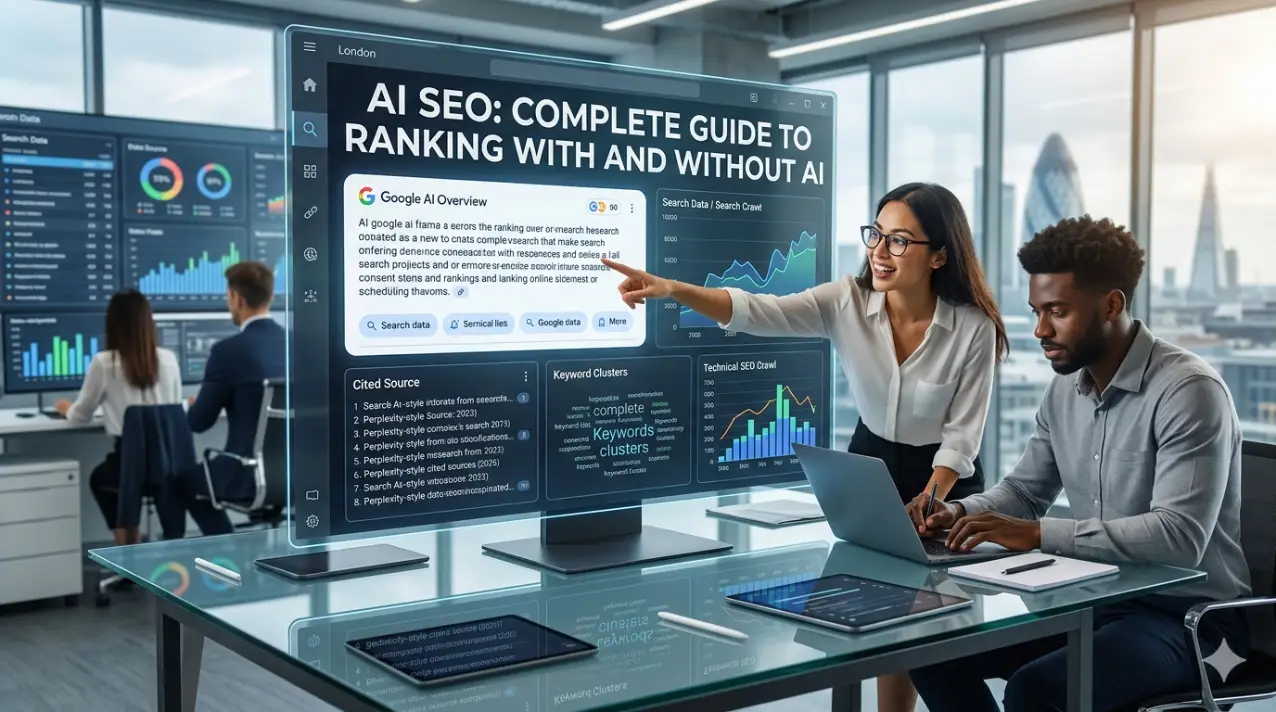
In 2026, SEO without understanding AI is like driving without knowing traffic rules. The search landscape has fundamentally changed: Google now generates AI Overviews for millions of queries, ChatGPT processes an estimated 2.5 billion prompts per day, and Perplexity has become a primary research tool for professional audiences. Together, these AI platforms have absorbed a meaningful share of traditional search traffic.
This guide explains what AI SEO actually means, how to optimise for AI-powered search platforms, and how to use AI tools strategically to improve your own rankings.
What Is AI SEO?
AI SEO refers to two distinct but related disciplines:
1. Optimising your content to be discovered and cited by AI-powered search systems — including Google’s AI Overviews, ChatGPT, Perplexity, Microsoft Copilot, and other AI assistants that retrieve and summarise information from the web.
2. Using AI tools to improve your traditional SEO — including AI-assisted content creation, keyword research, technical SEO audits, and link building outreach.
Most SEO professionals in 2026 need to do both: optimise for AI search and use AI in their SEO workflow. This guide covers both.
Part 1: Optimising for AI-Powered Search
Understanding How AI Search Systems Find and Cite Content
Google AI Overviews, ChatGPT, and Perplexity all retrieve information from the web using different methods, but they share common criteria for what content they choose to cite:
- Factual accuracy and specificity — vague, generic content is ignored. Precise, specific, verifiable information is retrieved.
- Clear, direct answers — AI systems retrieve content that directly answers questions. Content buried in long narrative paragraphs is harder to retrieve than content structured around clear Q&A or concise factual statements.
- Authoritative sourcing — content from sites with strong domain authority, established authorship, and citations from other authoritative sites is prioritised.
- Structured content — headings, numbered lists, tables, and FAQ sections make information machine-readable and retrieval-friendly.
- Freshness — for time-sensitive topics, AI systems prefer recently updated content.
This aligns closely with traditional Google SEO best practices — but with higher standards.
How to Appear in Google AI Overviews
Google’s AI Overviews (formerly Search Generative Experience) now appear for a significant proportion of informational searches. Research indicates that being cited within an AI Overview increases brand visibility substantially — even if direct click-through rates to your site from AI Overviews are lower than traditional organic results.
To optimise for Google AI Overviews:
Write in a question-and-answer structure. AI Overviews pull from content that directly answers the query. Use H2 and H3 headings that mirror common questions:
- H2: What causes a 404 error?
- H2: How do I fix a 404 error in WordPress?
- H2: How long does it take for Google to recognise a 404 fix?
Add a clear FAQ section to every article. Structure FAQs with the question as a heading and the answer in 2–4 concise sentences. This format is highly retrievable by AI systems.
Use tables and lists for factual information. Comparison tables, step-numbered processes, and bulleted feature lists are structurally easy for AI to retrieve and synthesise.
Get your key facts in the first paragraph. AI Overviews often pull from the opening section of an article. Lead with your most important, most specific information — not with a long preamble.
Mark up your content with structured data (Schema.org). While structured data does not guarantee AI citation, it helps Google understand the type and structure of your content. Article schema, FAQ schema, and HowTo schema are all relevant for informational content.
How to Get Cited by ChatGPT and Perplexity
Unlike Google, which crawls the web in real time, ChatGPT’s knowledge has a training cutoff — but its Browsing and Search features do retrieve live web content. Perplexity searches the web in real time for every query.
To be cited by these platforms:
Build domain authority through backlinks. AI systems that retrieve web content tend to prioritise sources that other authoritative sites link to. A site with 50 high-quality backlinks from industry publications is far more likely to be cited than a site with zero backlinks.
Publish original research and data. Content that contains original data, statistics, or findings gets cited by AI systems at a much higher rate than content that simply restates commonly available information. Even small-scale original research (a survey of 50 clients, an analysis of your own GSC data across multiple sites) counts.
Be specific and quotable. AI systems extract specific, precise statements. “GSC impressions dropped by 30–60% for most sites following Google’s September 2025 parameter change” is retrievable. “Many sites experienced significant impressions drops” is not.
Maintain a strong About page and author pages. When an AI system evaluates whether to cite a source, it assesses the credibility of the publisher. A clear, detailed About page explaining your expertise and a proper author bio with credentials signal a trustworthy source.
Build your brand’s mention footprint. If your brand name appears in other authoritative sources — mentions in industry articles, expert quotes, PR coverage — AI systems are more likely to recognise and cite you as an authority. For a technical SEO agency like 3wBiz, appearing in SEO industry roundups, being quoted in marketing publications, and contributing to community forums all build this mention footprint.
The Impact of AI Overviews on Click-Through Rates
AI Overviews reduce click-through rates for queries where Google can fully answer the question in the AI-generated summary. Research data from early 2026 suggests that when an AI Overview appears, the top organic result receives approximately 34% fewer clicks than it would without an Overview.
However — and this is important — being cited within the AI Overview itself increases brand visibility and clicks. Sites that are cited as sources within the AI Overview receive significantly more clicks than organic results that appear below an Overview but are not cited.
The strategic implication: your goal is not just to rank in position 1–3 below the AI Overview, but to be cited within the Overview itself. This requires the content quality improvements described above — direct answers, original data, clear structure, and strong E-E-A-T signals.
For commercial and transactional queries, AI Overviews appear far less frequently than for informational queries. If your content targets keywords with commercial intent (e.g. “technical SEO services UK”, “fix GSC errors for my site”, “wordpress speed optimisation agency”), AI Overviews are less likely to appear, and traditional organic ranking remains the primary traffic driver.
Part 2: Using AI Tools to Improve Your SEO
AI-Assisted Content Creation
AI writing tools (ChatGPT, Claude, Gemini, Jasper) can dramatically accelerate content production — but the March 2026 Core Update made clear that AI-generated content that provides no original value is now actively penalised.
The correct approach in 2026 is AI-assisted, human-edited content — using AI to produce a structured first draft, then adding:
- Original experience and examples from your own work
- Specific data and statistics
- Your own screenshots and visuals
- Your professional perspective and analysis
Content that is entirely AI-generated without any human editorial input or original value is the type of content that lost 60–80% of its traffic in the March 2026 update. Content where AI handles drafting and a human expert adds depth and originality is performing well.
Our AI writing service produces content using this exact approach — AI drafting combined with expert editorial review and original research integration.
AI for Keyword Research
AI tools have made keyword research faster but not simpler. Some practical applications:
Topic clustering: Ask an AI tool to generate a comprehensive list of subtopics, related questions, and related concepts around a seed keyword. Then validate search volume in Ahrefs or Semrush. This is faster than manual brainstorming and often surfaces angles you would not think of.
Search intent analysis: AI can quickly analyse the current top-ranking pages for a keyword and summarise the dominant content format, topic coverage, and search intent. This takes 2 hours manually and 5 minutes with AI.
Content gap identification: Give an AI tool your existing article and a competitor’s article and ask it to identify topics the competitor covers that you do not. This surfaces specific content gaps faster than manual comparison.
AI for Technical SEO
AI tools are increasingly useful for technical SEO tasks that previously required significant developer time:
Regex generation: AI can generate custom regex for GSC filters, robots.txt rules, and .htaccess redirect patterns on request — tasks that previously required a developer or significant technical knowledge.
Schema markup generation: Providing AI with your page content and asking it to generate valid JSON-LD structured data in a specific schema type is faster and more accurate than building it manually.
Log file analysis: AI can analyse server log files and identify Googlebot crawl patterns, crawl errors, and pages being missed — turning hours of manual log analysis into minutes.
Redirect mapping: When migrating a site, AI can process a list of old URLs and suggest redirect mappings based on URL structure and page content — dramatically reducing the time to build a comprehensive redirect map.
What AI Cannot Do for Your SEO
It is equally important to understand where AI tools fall short:
Building backlinks: AI cannot contact publishers, develop relationships, or do the outreach work required to earn high-quality backlinks.
Providing genuine experience: AI cannot replace the E-E-A-T signal that comes from real, first-hand experience. Google can detect when content lacks genuine experience, and AI-only content consistently underperforms experience-backed content.
Understanding your specific audience: AI tools work from training data averages, not from knowledge of your specific customers, their language, or their specific problems.
Real-time competitive intelligence: AI tools have knowledge cutoffs. For understanding what your competitors are doing right now, manual analysis and real-time tools (Ahrefs, Semrush) remain essential.
The AI SEO Strategy for 2026: Summary
| Task | AI Role | Human Role |
|---|---|---|
| Content drafting | Produce structured first draft | Add experience, data, examples, editorial review |
| Keyword research | Generate topic clusters, analyse intent | Validate volume, make strategic prioritisation |
| Schema markup | Generate JSON-LD | Review, customise, implement |
| Technical SEO | Generate regex, identify patterns | Diagnose root causes, implement fixes |
| Content structure | Suggest heading structure and FAQ | Diagnose root causes, implement fixes |
| Backlinks | N/A | Outreach, relationship building, PR |
| AI Overview optimisation | N/A | Structure content for retrieval, build authority |
Getting Started With AI SEO
If you are new to AI SEO and want to prioritise the highest-impact changes:
- Restructure your top 10 articles around question-based headings and FAQ sections — this is the fastest win for AI Overview citation.
- Add original data or case studies to at least one article per month — this is the most powerful differentiator from purely AI-generated content.
- Fix technical SEO issues — AI systems prioritise well-indexed, technically sound sites. See our technical SEO guide for a foundation.
- Use AI tools for production, not as a replacement — use AI to work faster, not to remove the human expertise that Google rewards.
For a tailored AI SEO strategy for your specific site and service niche, our team at 3wBiz offers a free consultation.